

DAILY ACTIVITY LOG TEMPLATE

This Daily Activity Log template enables you to document a typical day in your life and the
ways in which your disability impacts your daily life
Objective: demonstrate that impairment results in substantial reduction in functional capacity
“Substantial Reduction”:
- Applicant must demonstrate significant difficulty in at least one domain, rather than some
difficulty across multiple domains (GXYZ v NDIA [2020] AATA 3907).
- More than moderate – more than 50% reduced functional capacity to perform the activity;
“reduction” to consider levels of effort, discomfort or pain, slowness, changes to the way the individual participates in the activity (Burrows v NDIA [2025] ARTA 607).
- Should be measured against “ordinary person” with objective standard of basic function “consistent with day-to-day subsistence” (Burrows v NDIA [2025]).
- Sensory Disabilities: Issues affecting vision or hearing, as well as psychosocial disabilities
stemming from permanent mental health conditions, are recognised.
Key things to demonstrate:
- Inability to participate effectively or completely in an activity, or undertake related tasks or actions, without the use of assistive technology or home modifications; OR
- Usually requiring assistance from other people to participate in the activity or to perform tasks or actions required for this; OR
- Inability to participate in an activity even with the use of assistive technology or home modifications.
Note: all activities logged must pertain to one of following areas of activity
1. Communication (any form of self-expression to the end of communicating with others).
2. Social interaction (making friends, interacting with the community).
3. Learning (acquiring, practicing and learning new skills).
4. Mobility (moving at home or in the community).
5. Self-care (personal care and health).
- Note: In 2025, the Tribunal decided, in Burrows v NDIA, that domestic tasks (e.g. laundry,
gardening) do not fall within this nor any other category; focus more on tasks associated
with personal wellbeing and looking after your health.
6. Self-management (life organisation and administration)
The more tasks that you can demonstrate that you usually require assistance with in order to
perform them effectively, the better. You need to demonstrate that assistance is required on a
regular and consistent basis. The NDIA is also often interested in knowing what a good, average
and bad day looks like for you – you can make notes of days that you feel better, or days that
you struggle and require more assistance, in the “Issues Presented” section of each task line if
you like.
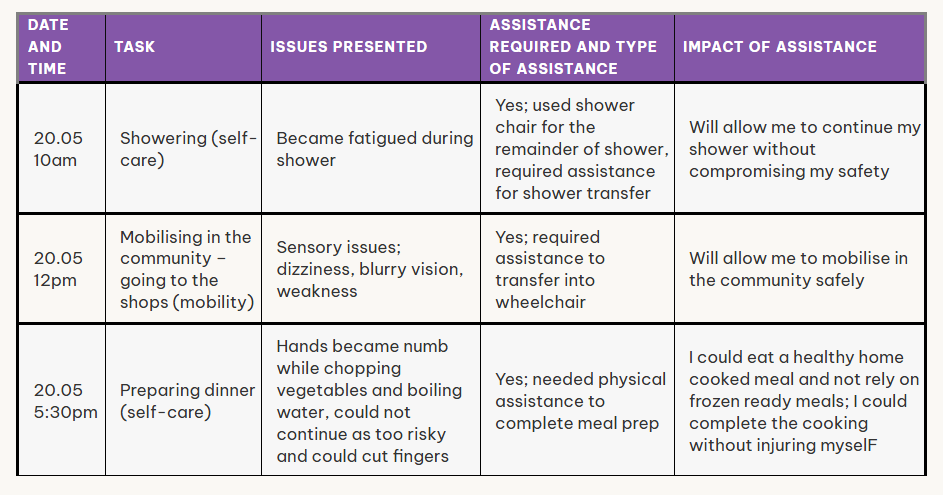
| DATE AND TIME | TASK | ISSUES PRESENTED | ASSISTANCE REQUIRED AND TYPE OF ASSISTANCE | IMPACT OF ASSISTANCE |
|---|---|---|---|---|
| 20.05 10am | Showering (self-care) | Became fatigued during shower | Yes; used shower chair for the remainder of shower, required assistance for shower transfer | Will allow me to continue my shower without compromising my safety |
| 20.05 12pm | Mobilising in the community – going to the shops (mobility) | Sensory issues; dizziness, blurry vision, weakness | Yes; required assistance to transfer into wheelchair | Will allow me to mobilise in the community safely |
| 20.05 5:30pm | Preparing dinner (self-care) | Hands became numb while chopping vegetables and boiling water, could not continue as too risky and could cut fingers | Yes; needed physical assistance to complete meal prep | I could eat a healthy home cooked meal and not rely on frozen ready meals; I could complete the cooking without injuring myselF |
Additional Resources
NDIS TOOLKIT – HERE